
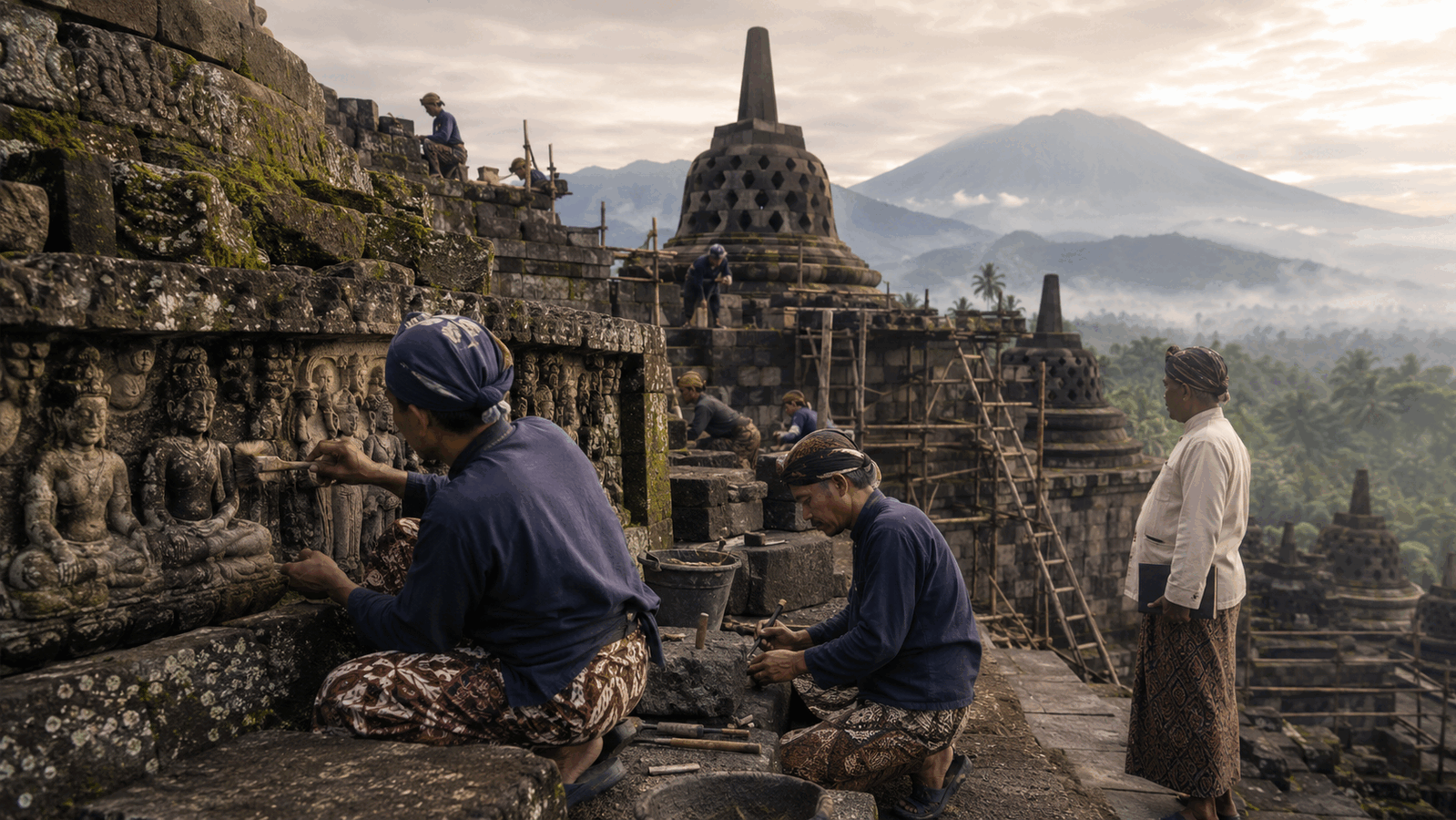
The Borobudur Early Restoration History explains the first efforts to protect one of Indonesia’s most valuable Buddhist monuments. After its rediscovery in the 19th century, researchers and authorities began studying the temple’s condition and searching for ways to preserve its structure.
Borobudur had suffered from centuries of neglect, natural weathering, and environmental exposure. Early restoration became an important step to prevent further damage and maintain the monument’s historical value.
The Condition of Borobudur After Rediscovery
When Borobudur gained attention in the early 19th century, the monument was not in perfect condition. Vegetation covered many areas, and parts of the structure had experienced damage from natural conditions.
The discovery revealed the importance of protecting the temple. Researchers recognized that Borobudur required careful maintenance because its stone structures faced risks from rain, erosion, and unstable conditions.
The early documentation provided valuable information about the monument’s condition. These records later supported more advanced conservation programs.
Visitors can understand more about this journey through Borobudur Temple history, origins, rediscovery, restoration, and legacy.
Early Preservation Efforts in the 19th Century
The first restoration activities began after Borobudur’s rediscovery. Initial efforts focused on clearing vegetation and removing materials that covered parts of the temple.
Researchers carefully examined the structure while documenting its architecture and relief panels. These studies helped experts understand the monument’s design and historical importance.
The early preservation process faced many challenges. Limited technology and resources made complete restoration difficult during that period.
However, these initial actions prevented further deterioration. They also increased awareness of Borobudur’s importance among historians and cultural researchers.
The Role of Research and Documentation
Documentation played a major role in Borobudur’s early restoration history. Researchers created drawings, notes, and reports about the temple’s condition.
These records helped identify damaged areas and provided references for future conservation work. Scholars also studied the reliefs to understand Buddhist teachings and ancient Javanese culture.
The research revealed that Borobudur was not only an architectural achievement. It was also a valuable source of information about the religious and social life of ancient Java.
Major Restoration Challenges
Restoring Borobudur was a complex process. The monument contained thousands of stone blocks and detailed carvings that required careful handling.
Experts needed to balance preservation with maintaining the original appearance of the temple. Incorrect repairs could damage historical elements.
Water drainage became one of the important concerns. Poor water management affected the stability of the structure and contributed to stone deterioration.
These challenges encouraged the development of more systematic conservation methods in later decades.
Modern Restoration and Preservation
The early restoration efforts created the foundation for larger conservation programs. In the 20th century, Indonesia worked with international organizations to protect Borobudur.
The largest restoration project took place from 1975 to 1982 with support from UNESCO. The project strengthened the monument and protected its artistic details.
Today, conservation teams continue monitoring Borobudur. They maintain the structure while managing tourism and environmental impacts.
Travelers who want to explore this preserved masterpiece can join a Borobudur Temple tour to learn about its history and restoration journey.
Conclusion
The Borobudur Early Restoration History shows the dedication required to protect an ancient monument. From early documentation to modern conservation programs, each effort helped preserve Borobudur for future generations.
Understanding the restoration process allows visitors to appreciate Borobudur beyond its beauty. Every stone and relief represents a story of discovery, preservation, and cultural heritage.

 Setya Andi Wardana
  Putri Rahman