
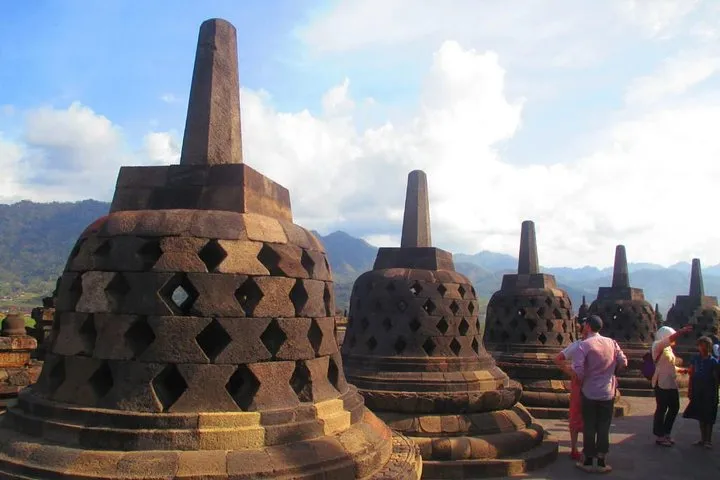
Borobudur is widely recognized as an important Borobudur Temple Buddhist monument in Central Java. Its enormous stone structure combines Buddhist symbolism, artistic reliefs, Buddha statues, terraces, and stupas into a carefully planned architectural complex. Understanding these elements can help travelers appreciate why Borobudur remains an important destination for cultural and religious tourism.
Borobudur Was Built as a Buddhist Monument
Borobudur was created during the ancient Javanese period as a monument associated with Buddhist traditions. Its architecture reflects religious ideas through the arrangement of terraces, galleries, statues, and stupas.
Unlike a conventional building with large interior rooms, Borobudur encourages visitors to move through its open galleries and pathways. The journey gradually leads from the lower terraces toward the upper circular platforms.
This architectural approach connects physical movement with Buddhist concepts.
The Monument Has Three Main Architectural Zones
One of the most important features of Borobudur is its division into three major architectural zones. The lower section contains square terraces, while the upper section consists of circular platforms.
These zones are traditionally associated with different stages of Buddhist cosmology. The architecture becomes progressively simpler as visitors move upward.
This transition creates a visual and physical journey from the detailed lower galleries toward the open space surrounding the central stupa.
Reliefs Communicate Buddhist Teachings
The walls of Borobudur contain thousands of carved relief panels. Many scenes relate to Buddhist stories, teachings, and moral ideas.
The carvings also portray people, animals, buildings, plants, and other elements that provide a broader picture of the world represented by the artists.
Visitors encounter these reliefs while walking through the galleries. As a result, the artwork becomes part of the journey rather than something viewed separately from the architecture.
For travelers who want to learn more about Borobudur’s history, architecture, Buddhist meaning, and interesting details, this Borobudur facts guide provides additional information.
Buddha Statues Appear Throughout the Monument
Buddha statues form another important part of the monument. Many statues sit inside niches along the square terraces.
Additional Buddha figures are positioned inside the perforated stupas on the circular platforms. Their placement creates a strong relationship between sculpture and architecture.
The statues also contribute to the sense of repetition and balance found throughout Borobudur.
Stupas Define the Upper Platforms
The circular platforms are particularly famous for their rows of stupas. These structures surround the large central stupa at the summit.
Many of the surrounding stupas have perforated stone surfaces. Through these openings, visitors can see parts of the Buddha statues inside.
The repeated arrangement creates a distinctive visual pattern and gives the upper section a different character from the relief-filled galleries below.
A Monument Designed for Spiritual Progression
The architecture of this Borobudur Temple Buddhist monument encourages visitors to move upward through different spaces. Walking through the galleries, climbing the stairways, and reaching the circular platforms creates a gradual progression.
The physical journey can be understood alongside Buddhist ideas about spiritual development. The monument therefore combines architecture and religious symbolism within one continuous experience.
Experiencing Borobudur Today
Today, visitors can explore Borobudur while learning about its Buddhist heritage and ancient architectural traditions. Observing the reliefs, statues, terraces, and stupas together provides a clearer picture of how the monument functions as a complete design.
Travelers who want to visit Borobudur and other destinations around Central Java can also explore Borobudur Tours.
The Borobudur Temple Buddhist monument remains an important example of how architecture can express religious ideas. Its combination of artistic detail, symbolic structure, and carefully planned movement continues to make Borobudur a significant cultural landmark.

 Putri Rahman
  roha Roha